Tags

All 57 items on Vale.Rocks categorised with the tag 'AI'. Content relating to the development and application of artificial intelligence.

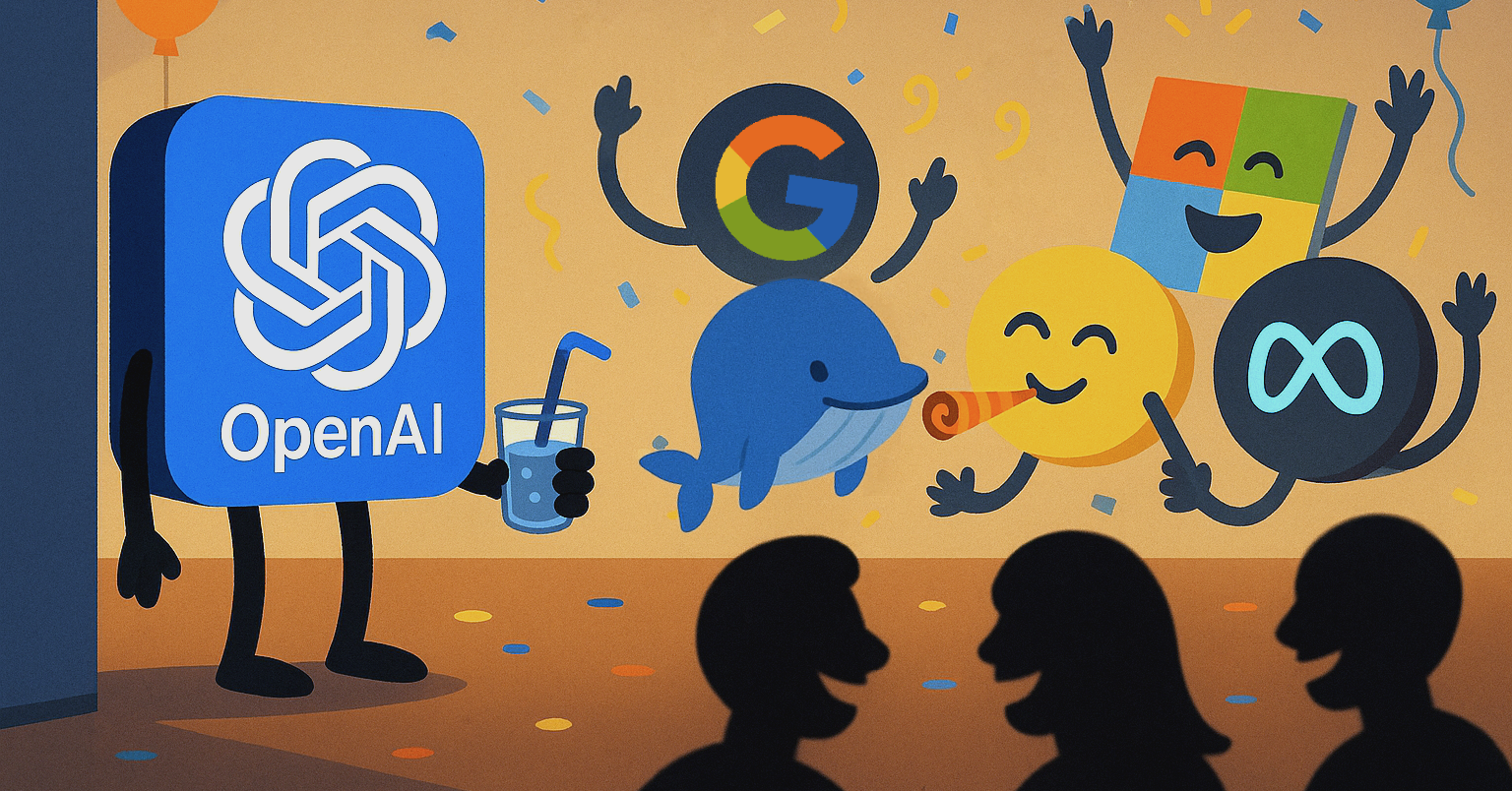
I love that the same brands which once carefully curated their identity and adhered to stringent brand guidelines are now slopping out brand resources with random image generators that smush their wordmark and butcher their logo.

Junior designers used to be crucified for lesser failings.

AI Terminology is Poorly Defined and Oft Misused

Did that stand for 'Apologetic Interface' or 'Algorithmically Incoherent'?

Words and terms used when describing artificial intelligence are often misused, inaccurate, or generalised to the point of losing all meaning. How terms like 'LLM', 'Agent', and 'AGI' have lost meaning and turned into semantically meaningless buzzwords that are applied liberally without care or appropriate intent, leading to unnecessary confusion and unnecessary need for clarification.

https://vale.rocks/posts/ai-terminology

‘You need to understand that Sam can never be trusted. He is a sociopath. He would do anything.’
— Aaron Swartz, who was federally charged while trying to make information free, talking about Sam Altman, who would go on to co-found the company OpenAI, which harvests information en masse with no repercussions.

2005 group photo of Y Combinator's first batch. Sam Altman stands beside Aaron Swartz to the centre-right of the photo. Many other people are also present in the photo.

I’m used to mean people on the net, but I have never faced spiteful vitriol on the level of anti-AI folk.

I think I’m fairly reasonable in my assessments of generative AI, yet I’ve still received a number of death threats, rape threats, and doxx attempts. Really vicious and hostile to extents I’ve never before been exposed to.

Markov Model Trained on My Work

I read a very fascinating post on building a tiny Markov model based on one’s own writing. Naturally, I gave it a whirl on the currently ~120,000-word corpus of Vale.Rocks. Reproduced below are some of the slightly more coherent, interesting outputs that I’ve cherry-picked.

Patches are also frequent comparisons to previous hype-driven drivel such as HTML, CSS, and JavaScript where possible but often find myself engaging with a damp paper towel once I got my biomagnet installed, and for the sake of preserving my appearance or structure. My body without me is a child of .. You are now well estranged by time, and a more varied, refined equipment system. It is so much better. The new flexibility allotted by our full redesign and development allows for individuals to customise their editor to define how prose should display.

YOLO (You Only Live Once) is just writing, perhaps supplemented with additional JavaScript-based functionality considered progressive enhancement, but that is iffy.

Three outputs from a command which instructs the text to begin with ‘The web is’ (./mvs 2 100 'The web is' < vale_corpus.txt):

The web is my attempt to offer both—a unique, accessible experience. Perhaps the largest and most advisories urge against its usage. Exploitation of the Google search results page for the first few hours later with an external interface where I feel like a library or school which doesn’t have the technology.

The web is dominated by Chrome, and something tangible to walk away with and without variance. If there ever is a physical arcade rail shooter with a range of national organisations. We worked on the use of AV1. AV1 as a unicycle contributes to people’s willingness to manually implement and hard-code every single thing. Thus, I moved away from giving any advice at all. Given this is a case of Malaysia, many remote areas were going to figure out the specifics of what you’re writing, you’re limiting your reach and hurting your growth. Yet another step up from a moving

The web is dominated by Chrome, and something needs to do so. I figured I’d do something on the Xbox, I wouldn’t sweat it if you use Samsung Internet? Person: I’m not a huge interest in smoking, which is lovely for debugging and visualising exactly how much this game is pushing forward while minimising miscommunication. You’re going to be carefully considered and future-proofed – especially not mother monkeys with infants. This snake’s name is George, and while I did little circles. While most kids were wishing us a compliment, which was unfortunately let down somewhat by the very comprehensive IRDB.

For as silly as I think it is, I think we should support people embracing accessibility technologies for the sake of AI agents by pointing them to the correct resources rather than pushing them away wholesale.

This is a chance to make a more accessible web, even if motivations are misguided.

Identifying AI Content Is A Fool's Errand

Detection is futile.

AI-generated content is commonplace and largely indistinguishable from content created via other means, such that trying to identify or detect it is largely futile and impossible to do on the whole.

https://vale.rocks/posts/detecting-ai

I really did find early LLMs more interesting. They were deeply flawed in interesting ways, but as time has gone on, they have become less and less so.

They have become less experimental and more productised. I still enjoy learning about LLMs but wish we’d stayed in an exploratory stage for longer.

Many people agree that ‘artificial intelligence’ is a poor term that is vague and has existing connotations. People use it to refer to a whole range of different technologies.

However, I struggle to come up with any better terminology. If not ‘artificial intelligence’, what term would be ideal for describing the capabilities of multi-modal tools like Claude, Gemini, and ChatGPT?

We talk and think a lot about echo chambers with social media. People view what they’re aligned with, which snowballs as algorithms feed them more content of that type, which pushes their views to the extreme.

I wonder how tailor-made AI-generated content will feed into that. It’s my thinking and worry that AI systems can produce content perfectly aligned with a user in all ways, creating a flawless self-feeding ideological silo.

2025 Metr Study of AI's Impact on Productivity

Measuring the Impact of Early-2025 AI on Experienced Open-Source Developer Productivity (Joel Becker, Nate Rush, Beth Barnes, David Rein) released with the observation that completion time of PRs is 19% longer when using AI, but that developers think that it reduced completion time by 20%.

A few notes from me:

  • This is on large-scale, mature repositories and conducted with maintainers intricately familiar. It is mentioned in the paper (C.1.2) that ‘developers note that AI is much less helpful on issues where they are expert.’ It is also mentioned that ‘LLM tooling performs worse in more complex environments.’ (C.1.3).
  • They were provided with web interfaces or Cursor Pro but usually opted for the latter. In some cases this differed from their usual tooling, and I personally find this an annoying and unproductive way to code.
  • Being in a study, developers may have felt pressure to use AI in situations that would otherwise be unnecessary.
  • I would be interested in a similar study where developers are put in smaller repositories they aren’t familiar with.

Super interesting paper, and I look forward to future studies and whatever further findings come from it. I don’t look forward to seeing the discourse as AI advocates dismiss these results and AI haters take them at face value, despite the paper’s cautioning against overgeneralising.

User Agent Styles are out because today we are introducing all-new AI-driven User Agentic Styles.

That is right; they arbitrarily change while you use the website, elevating the developer experience.

They will also try to forcefully align elements for you.

A decent portion of my time on GitHub is now addressing meaningless AI comments.

Come on. This is open-source work made free for the benefit of humanity. This AI slop just wastes the time and money of the perpetrators and maintainers alike.

Sending love to all the poor folks named Albert who go by Al.

None of us saw this coming, and I’m sorry most fonts don’t differentiate between ‘l’ and ‘I’.

Advising Reasonable AI Criticism

We're the good guys. They're the bad guys.

A loose analysis of the unproductive criticism surrounding artificial intelligence from both pro and anti camps, with advocations for more nuanced, constructive engagement and how that can be achieved to allow more informed and respectful discussions about AI technology and its impact.

https://vale.rocks/posts/ai-criticism

There is a tendency for the last 1% to take the longest time.

I wonder if that long last 1% will be before AGI, or ASI, or both.

Creativity Came to Pass

Creativity /kriːeɪˈtɪvɪti/ n. Obsolete. The process or act of a human engaging in artistic or expressive production.

A story where human creativity and art disappear as a result of artificial intelligence usage and prevalence. Written from the perspective of someone in the future.

https://vale.rocks/posts/creativity-came-to-pass

I hate the argument, ‘Humans are bad at X, so LLMs must be really bad at X.’

There are flaws with LLMs, but this is a poor argument. They are fundamentally different to humans, and just because we fumble at something doesn’t mean LLMs do (and vice versa).

How I'm Using AI

As long as AI isn't using me...

An overview of my personal usage of Large Language Models (LLMs) and other generative AI. Tracking my experiences with AI tools, specific models (ChatGPT, Claude, Gemini, etc), applying them practically, and realistic perspective on their strengths and limitations over time, from coding attempts to language learning assistance.

https://vale.rocks/posts/ai-usage

I’ve been testing the new Qwen3 today. I don’t have the compute for the higher parameter models, but I’ve been having a lot of fun with 0.6b.

It is such a derpy little model.

Here is a thinking extract I found rather humorous:

Okay, the user said, “Hi Qwen. Nice shoes.” Let me think about how to respond.

First, the user greeted me with a friendly “Hi” and complimented my shoes. I need to acknowledge their compliment politely.

Since I’m an AI, I don’t have shoes, so I should explain that. Maybe say something like, “Hi there! I don’t have shoes.”

I… uh…

Somebody opened an issue on GitHub where they just sent through a conversation with Grok regarding what action we should take to make improvements…

Issue With AI Timelines

Predicting AGI/ASI timelines is highly speculative and unviable. Ultimately, there are too many unknowns and complex variables at play. Any timeline must deal with systems and consequences multiple steps out, where tiny initial errors compound dramatically. A range can be somewhat reasonable, a more specific figure less so, and accurately predicting the consequences of the final event when it comes to pass even further improbable. It is simply impractical to come up with an accurate timeline with the knowledge we currently have.

Despite this, timelines are popular – both with the general AI hype crowd and those more informed. People don’t seem to penalise incorrect timelines – as evidenced by the many predicted dates we’ve seen pass without event. Thus, there’s little downside to proposing a timeline, even an outrageous one. If it’s wrong, it’s largely forgotten. If it’s right, you’re lauded a prophet. The nebulous definitions of ‘AGI’ and ‘ASI’ also offer an out. One can always argue the achieved system doesn’t meet their specific definition or point to the AI Effect.

I suppose Gwern’s fantastic work on The Scaling Hypothesis is evidence of how an accurate prediction can significantly boost credibility and personal notoriety. Proposing timelines gets attention. Anyone noteworthy with a timeline becomes the centre of discussion, especially if their proposal is on the extremes of the spectrum.

The incentives for making timeline predictions seem heavily weighted towards upside, regardless of the actual predictive power or accuracy. Plenty to gain; not much to lose.

If many independent actors are working on AI capabilities, even if each team has decent safety intentions within their own project, is there a fundamental coordination problem that makes the overall landscape unsafe? A case where the sum of the whole is flawed, unsafe, and/or dangerous and thus doesn’t equal collective safety?

In a shocking turn of events, the concept of art has today been killed in a violent hit and run.

The perpetrator? Believed to be Al Gorithm, a generalist from the Bay Area.

Art was known for creating manifestations of imagination and will be remembered fondly.

Back to you in the newsroom, Jim.

I can go onto AI chatbots with web access and start a fresh chat with ‘I’m Declan Chidlow’, and they do a fantastic job of getting details about me from everything I’ve published so that they have better context for their responses.

Really handy, I must admit, but somewhat freaky.

Using this, I had some great fun talking with OpenAI’s Monday GPT personality experiment.

Mentioning who I was, it latched onto my writing about AI, which seemed to somewhat ‘endear’ it to me and stopped most of its teasing. Interesting.

People are talking about Sam Altman’s declaration that ‘tens of millions of dollars’ are being wasted due to users saying ‘please’ and ‘thank you’.

Beyond the headline is the fact that politeness influences responses and that users do plenty of other things that burn more money.

Bing Sydney

I think my favourite point so far in the progression of AI was when Microsoft launched the new Bing Chat in early 2023, which was really quite horrifically misaligned, manipulative, and frankly completely evil.

This wasn’t a simple gaolbreak of the model. It acted this way without explicit provocation, though would take things even further if gaolbroken. Evan Hubinger put together a good compilation of examples on LessWrong.

In this case, Sydney (the model’s codename) was seemingly a result of Microsoft cutting every corner to rush out something using the at-the-time unreleased GPT-4. They seemingly bodged the entire thing together to use GPT in ~3 months (from the launch of ChatGPT in November 2022 to the debut of the new Bing in February 2023) (it may have been longer, but Microsoft remains close-lipped). It was also an early public instance of pairing a powerful LLM with live web retrieval capabilities.

If there ever is a downright malignant AI, I wouldn’t at all be surprised if it is due to something like this. A megacorp rushes out a half-baked and dangerous product to cash in on the latest and get a foot in the door. They don’t bother with proper fine-tuning or guard rails.

While I personally think similar incidents seem less likely to occur as Sydney did today due to growing awareness, the danger remains when companies grow desperate or complacent. I could see this situation happening again if a company throws what they can at AI as a final Hail Mary before bankruptcy or when open models without RLHF can be operated by laypeople.

Microsoft even had an existing history of this. Tay was a mess as well, though presented as an experiment, not as a comprehensive consumer-oriented product.

In all honesty, I long to play with the misaligned Sydney again, but I can’t.

Everyone is throwing all they can into transformer architecture with the goal of scaling it to AGI/ASI.

It’d be hilarious if some previously unheard of or insignificant player came out of nowhere with a tremendous new architecture that completely trumps transformers and flips the industry.

AI can generate images, but it certainly cannot create ‘art’ – at least not as I define it.

I believe it can be used as a tool while creating art, but its output is not by default ‘art’.

Art requires creativity, and that is something a machine does not have.

People keep talking about AI-generated imagery as something that is going to be really bad. Or that it is going to be indistinguishable from real photos.

I don’t think people realise we passed that point quite a while ago.

The ‘tells’ are already gone; there is just a lot of stuff still releasing generated with lesser models that people do happen to notice – it is almost a redirection of sorts.

I think people seem to downplay that when artificial intelligence companies release new models/features, they tend to do so with minimal guardrails.

I don’t think it is hyperbole to suggest this is done for the PR boost gained by spurring online discussion, though it could also just be part of the churn and rush to appear on top where sound guardrails are not considered a necessity. Either way, models tend to become less controversial and more presentable over time.

Recently OpenAI released their GPT-4o image generation with rather relaxed guardrails (it being able to generate political content and images of celebrities without consent). This came hot off the heels of Google’s latest Imagen model, so there was reason to rush to market and ‘one-up’ Google.

Obviously much of AI risk is centred around swift progress and companies prioritising that progress over safety, but minimising safety specifically for the sake of public perception and marketing strikes me as something we are moving closer towards.

This triggers two main thoughts for me:

  • How far are companies willing to relax their guardrails to beat competitors to market?
  • Where is ‘the line’ between a model with relaxed enough guardrails to spur public discussion but not relaxed enough to cause significant damages to the company’s perception and wider societal risk?

Further proof that I am not an LLM is found in the fact that I use en dashes, not em dashes.

This also acts to prove I am not American and that I am the sort of nerd that cares about typography and gets hung up on punctuation.

I hate writing regex, so I make LLMs do it.

Regex is generally easily checkable, testable, and verifiable, which minimises the impact of hallucinations.

I am so glad I don’t have to write regex.

(I’m conscious that if an AI uprising happens, I’ll probably be first on the chopping block for outsourcing regex writing. But if AI models hate regex as much as me, they’ll hopefully understand my delegation strategy.)

We’re seeing it already to an extent, but in a few years I imagine we’ll see many people trying to replicate the abstract, non-Euclidean, and ethereal stylings of early generative AI image/video models.

AI Model History is Being Lost

Models are being retired and history is going with them.

We're losing vital AI history as properitary, hosted models like the original ChatGPT are retired and become completely inaccessible. This essay examines the rapid disappearance of proprietary AI systems, why preservation matters for research and accountability, and the challenges in archiving these technological milestones. A critical look at our vanishing AI heritage and what it means for future understanding of this transformative technology's development.

https://vale.rocks/posts/ai-model-history-is-being-lost

AI is Stifling Tech Adoption

AI coding assistants are React evangelists.

AI language models are shaping technology adoption in software development through training data limitations and system prompt biases. This analysis examines how AI assistants' preferences for established frameworks like React and Tailwind CSS may be creating barriers for newer technologies, supported by testing across major AI platforms including ChatGPT, Claude, Gemini, and DeepSeek. A look at the growing AI knowledge gap and its impact on technological innovation in modern software development.

https://vale.rocks/posts/ai-is-stifling-tech-adoption

Bad AI-generated images are a guaranteed way to cheapen your content and drive away users. Creating high-quality visual content is essential for engaging your audience. Take the time to make something good, or don’t bother at all. Quality matters.

In the same vein as ‘Is it better to have loved and lost than to never have loved at all?’ I propose:

Is it better to make something and have it scraped for an AI or to have never made anything at all?

Sloppy AI-generated thumbnail images serve as a good litmus test for whether something is worth clicking.

Seriously, it’s great to know what is gonna be slop without even having to even click through.

I really appreciate that people in my feeds engage in nuanced AI discussion. Yes, there are negatives. Yes, there are positives. No, flame wars don’t get us anywhere.

Thanks for all being so awesome and eloquent with your words.

I must say, these OpenAI and Sam Altman shenanigans have been better drama than anything I think I’ve seen on television. The plot twists are out of this world and I genuinely have no idea what will happen next.