Tags

All 7 items on Vale.Rocks categorised with the tag 'SEO/GEO/AIO'. Content relating to SEO, GEO, and the optimization of content for search and generative engines.

I picked the TLD for this site without any great deal of thought – certainly with less deliberation than I would now. The idea was ‘Vale (me) rocks!’. A bit of a tongue-in-cheek ego play. Stumbling around the web, I found Vale.Rocks listed as one of the top websites using the .rocks TLD. Surely not, I thought. Vale.Rocks represents so much work and is my greatest creation, but it is niche.

Indeed, it is far from the biggest by measures of quantity of backlinks or traffic. However, it is quite highly placed (position 94,257) in the Majestic Million, ‘the million domains we find with the most referring subnets’. What does that mean? It means that instead of counting backlinks or traffic directly, it ranks based on how many subnets – that is, ranges of IP addresses (specifically, C-class subnets) – refer to a given site. Thus, the highest-ranking sites are those referred to by the widest variety of places on the web because links from the same subnet are collapsed into a single vote.

Filtering by the .rocks TLD, it is presently in position 4 on the list, after activitypub.rocks, kif.rocks, and koreader.rocks. This indicates that while Vale.Rocks might not be the most popular site, it is one with a broad backlink profile, with links originating from a wide variety of networks from all over the web.
Starting in late September, large quantities of traffic purported to be referred from https://www.aocr.org/ began appearing in site analytics across the web. This is not traffic from the eponymous American Osteopathic College of Radiology but is instead of a more nefarious nature. Usually I see no note of bot traffic in my site analytics, but this specific case managed to get through many sites’ defences and muddy the data. Some investigations have been performed, but most are seemingly AI slop feeding off each other, so I’ve combed through logs, run my own tests, and conducted a small survey to get some traffic analytics from various people.

It is first important to note that a referrer is not a verified value in any way. Anyone can put anything in the Referer header with no need to prove that it is actually coming from the location specified. This suspicious traffic doesn’t appear to be scoped to a specific type of content, as I can find referrals in the analytics of seemingly completely unrelated websites.

With a small number of outliers, the traffic associated with the referrer has these identifiable properties:

Property Details
User Agent Mozilla/5.0 (Windows NT 10.0; Win64; x64) AppleWebKit/537.36 (KHTML, like Gecko) Chrome/146.0.0.0 Safari/537.36
Accept text/html,application/xhtml+xml,application/xml;q=0.9,image/heif,image/avif,image/webp,image/apng,*/*;q=0.8,application/signed-exchange;v=b3;q=0.7
Sec-Fetch-Site none
Resolution 800 × 600
Timing fields
extensionTiming
    forestResFrom
    forestResLoadStart

htmlPredictorHit

These properties have similarities with ByteSpider – the web crawler operated by Chinese company ByteDance – but it is not the same and is not entirely consistent. The browser in use is, however, almost certainly of ByteDance origin. ByteDance has a cloud computing arm called Volcano Engine (火huǒ山shān引yǐn擎qíng) which offers browser-as-a-service functionality within China. The global version is BytePlus, which I poked around to understand their browser. Most importantly, BytePlus’ browser is extraordinarily similar to the browser sending these aocr.org referral traffic. It is a full browser that executes JavaScript, which is generating this traffic, and not just performing a fetch. This is probably a large part of why it showed in so many sites’ analytics – it executed the analytics scripts.

As for the timing field values, forest most likely refers to a resource loader developed by ByteDance, which we can find mentioned in the code of the cross-platform framework Lynx, which is used for applications like TikTok. The exact forest strings are absent from BytePlus’ browser-as-a-service, which is the most glaring disparity, though ByteDance-specific fields are present. The Accept header is also distinctive. It is identical to stock Chromium’s with the exception of advertising image/heif support, which stock Chromium doesn’t. The only browser at time of writing to have support for the format is Safari, so it is odd for it to be included. This is further evidence suggesting that ByteDance’s Browser-as-a-service is in use. I’m inclined to believe this aocr.org traffic is using a newer version which is perhaps provided somewhere unknown to me. This age difference is corroborated by the Browser-as-a-service having a ClientHello message that is 512 bytes, X25519 only, while this aocr.org referrer is 1,722–1,818 bytes, PQ class, which is more in line with newer browsers.

Across all sites with traffic from aocr.org, I’ve found a small spike around October 27th-30th and a significant spike on November 5th/6th where the same pages were fetched multiple times. The majority of traffic is from United States IPs, with Brazil as a follow-up and a wide variety of countries beyond that. The IPs are from a wide array of data centres and residential addresses, though these are proxies and the browsers are almost certainly running in China due to that being the only region ByteDance’s browser-as-a-service supports.

There is no obfuscation or attempt to rotate the referrer. It is extremely predictable and consistent with the only thing that seems to change being the origin IP with occasional small variation in the user agent. A genuine page referral from a clicked link will also have a Sec-Fetch-Site of cross-site, not none as the spider provides. Having no referrer header would likely have seen the request blocked, though had they cycled referrers, many people probably wouldn’t have noticed.

I’m left with four questions I cannot answer to a satisfactory degree:

  • Why choose aocr.org? Likely because it is an established, non-commercial, old domain (registered 1999) that seems innocuous at first glance? It is in the Majestic Million and Tranco lists, so it was probably chosen at random from there.
  • Why not change referrers to avoid arousing suspicion? Unless the goal is to arouse suspicion for some purpose or to identify sites which fail to react and implement protections. Or it could have been a value mistakenly hard-coded, set as a variable, or forgotten as a default.
  • Who is running this? Is it a single entity or are there many parties involved? Given the scope of the scraping and how many different servers and proxies are used, it seems unlikely to be more than a single controlling party.
  • What is the purpose? I’m inclined to put forward AI scraping, as advertising fraud or traffic laundering don’t make sense. AOCR aren’t trying to get clicks from curious webmasters, and the affected sites haven’t paid to receive traffic.

ByteDance’s PaaS/IaaS/SaaS offerings, Volcano Engine (火huǒ山shān引yǐn擎qíng) and BytePlus, are both rather similar services under-the-hood, with the former serving domestic China and the latter the rest of the world. They both offer a range of services, including browser automation under Volcano Engine’s Function as a Service (veFaaS).

However, the Chromium they offer isn’t quite stock and instead has some modifications. Inspecting the logs, I found mention of this Docker image: enterprise-public-ap-southeast-1.cr.volces.com/vefaas-public/browser-pool:latest. Curious, I, of course, downloaded it and investigated.

As of writing, the latest version of this image is from September 5th, 2025, and contains two browser versions. The first is a completely standard version of Chromium 136.0.7103.25 (/ms-playwright/chromium-1169/chrome-linux/chrome). However, alongside it and used by default is a version referred to as ‘enhanced’. This is Chromium 117.0.5938.60 (/opt/chromium.org/browser_use/chromium/chrome) and is chosen by enable_enhancement=true.

My interest is in what this ‘enhancement’ is, as I believe it extremely likely that this is an older version of the browser which powers ByteDance’s infamous ByteSpider web crawler/scraper. Comparing to ByteSpider, it matches the Accept header of the ByteSpider-matching subset, which advertises HEIF support not present in standard Chromium (text/html,application/xhtml+xml,application/xml;q=0.9,image/heif,image/avif,image/webp,image/apng,*/*;q=0.8,application/signed-exchange;v=b3;q=0.7).

Chromium 117 ‘enhancement’ contains these instrumentation strings: TTGlobalHeadless/TTHeadless, bytedance/loading, and probe. I assume the ‘TT’ refers to TikTok, which would make sense, as ByteDance is known to operate ‘TikTokSpider’ and uses ‘TT’ in the names of frameworks, APIs, SDKs, and other developer tools. It could also refer to 头tóu条tiáo.

If this is of the ByteSpider family, I take it to be an older version, as the TLS ClientHello record is 512 B and X25519 only, while ByteSpider’s has been observed to be 1,722–1,818 B and PQ class, which is in line with more modern versions of Chrome.

It is, of course, possible that this is merely how ByteDance modifies their browsers, and it has no association with ByteSpider at all. More testing is necessary to ascertain whether modern ByteSpider ever includes the forest timing fields seen with the suspicious aocr.org referring crawler/scraper.

Google Search Central made a post on LinkedIn, and it has the most genuine human-written comments I’ve ever seen on the platform. It is just a bunch of SEO experts saying variants of: ‘We’re fucked’, ‘Our careers are ruined’, ‘All our traffic is gone’, ‘Google wants us dead’.

:(

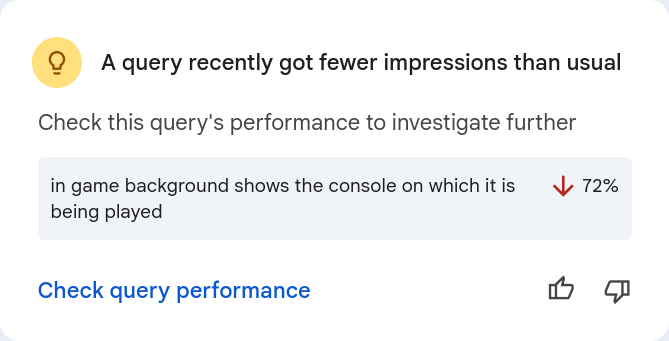
Also, oh, okay. Thanks Google. I was wondering where all the traffic went.

Google Search Console notice reading 'A query recently got fewer impressions than usual. Check this query's performance to investigate further. "in game background shows the console on which it is being played". Down 72%.'

For most of the world, Google Search is the search engine. So much so that it has become a verb in conversation – to ‘Google’ something. Even if you use another option, you still likely think of Google Search first.

However, there are many countries where Google has fierce competition and is even sometimes surpassed. In China, Baidu Search is the standard, with Bing holding a fairly significant market share as well. In Russia, Yandex dominates the search market. Popular in South Korea is Naver.

There are also some countries where non-Google search engines have a significant hold, but not quite as substantial. Yandex is popular in Russia’s neighbouring countries: Belarus, Kazakhstan, Uzbekistan, and Turkey. Yahoo! and Bing are both rather popular in Japan. Seznam remains rather popular in the Czech Republic, and Cốc Cốc does reasonably in Vietnam.

A common reason for these engines being popular is their handling of local languages using non-Latin scripts. Censorship and compliance with government regulations also influence their success.

These search engines are worth keeping front of mind if you’re targeting an aforementioned country or localising for them.

SEO is not a game of absolutes, and anyone who acts to the contrary is dubious at best.

Search engine optimisation is extremely complex. By design, nobody has a completely full and comprehensive understanding of search engine ranking – not even the people working at those search engines. This is intentional and done to prevent exploiting the system.

The same is true for Generative Engine Optimisation (GEO) or Artificial Intelligence Optimisation (AIO), but to an ever greater extent. LLMs are so complex and trained on so much data that they regularly do things unprompted and act in ways uninstructed. As it stands, even someone who knew all about the functionality of the models would be unable to speak in absolutes.

I’m not saying that SEO folk are scammers or conspicuous (though some are), but SEO/GEO/AIO experts who speak with complete certainty and in absolutes are doing so from a place of sales, not truth.

Bing Webmaster Tools just generally suck, yeah? Surely it can’t just be me that finds them super buggy and can rarely get them to index anything.

Does anyone have experience with them working nicely?